Why Does Your Warm-Up Reveal Overtraining Before Your Working Sets Do?
Quick Answer: Working sets recruit adrenaline, motivation, and every compensatory strategy your body has, which masks accumulated fatigue. Warm-up sets are performed at low intensity with none of that assistance, so they reflect your true recovery state. A warm-up that feels unusually heavy, slow, or effortful is one of the earliest and most reliable signals that you are under-recovered.
The heavy set felt fine. You told yourself the session was good.
The empty bar told you the truth four minutes earlier and you were not listening.
This is general information, not medical advice.

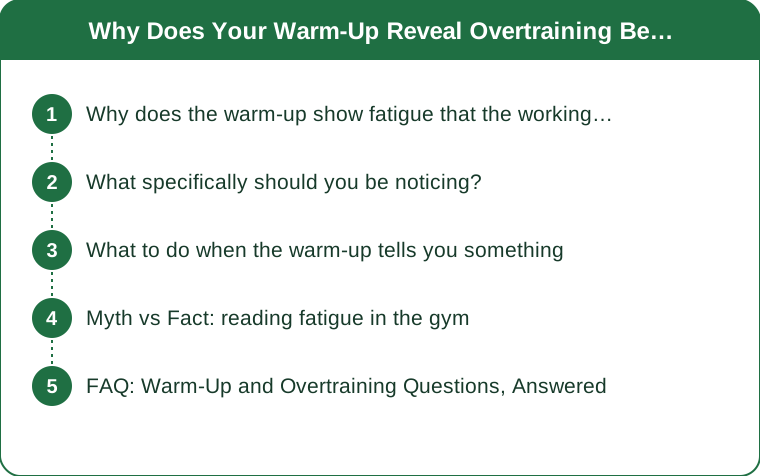
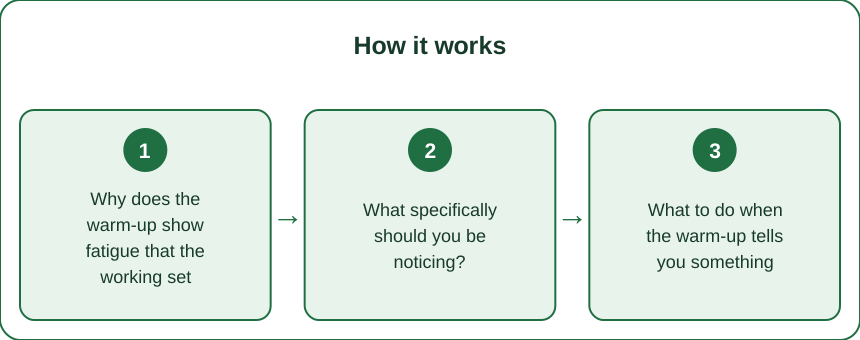
Why does the warm-up show fatigue that the working set hides?
Because arousal is a performance-enhancing drug you produce yourself.
As intensity rises, your body recruits a stress response — catecholamines, elevated arousal, heightened focus. This genuinely improves force production and pain tolerance in the moment. It is why people hit personal bests on days they felt terrible walking in.
That response does not switch on for a set of eight with the empty bar. There is nothing to be aroused about. So the warm-up gets performed by your baseline system, without the emergency top-up — which makes it a much cleaner measurement of how recovered you actually are.
There is a second mechanism. Warm-up sets are performed at speeds and loads you have done hundreds of times, so you have an unusually precise internal reference for how they should feel. A deviation of ten percent in how heavy 40 kilos feels is immediately detectable. The same deviation on a near-maximal set is buried in the general difficulty of the effort.
The practical consequence: your warm-up is a free daily readiness test you are already performing and probably not reading.
Is this the same as bar speed tracking?
Related, and simpler. Velocity-based training measures the same underlying phenomenon with equipment. Paying attention to how the warm-up feels captures much of the signal for free.
What specifically should you be noticing?
Four things, in rough order of usefulness.
1. Perceived weight of a known load. The clearest signal. Your standard second warm-up set has a familiar feel. When it feels distinctly heavier than usual — not slightly, distinctly — that is meaningful information about recovery.
2. Bar speed at submaximal loads. Warm-up sets should move quickly and easily. When a load you would normally throw around feels sluggish, that reflects central and peripheral fatigue rather than a technique problem.
3. How long it takes to feel ready. Everyone has a normal number of warm-up sets. Needing noticeably more before movement feels smooth is a common early sign, and one that people rationalize as being cold or having slept awkwardly.
4. Joint and tissue feedback at low load. Warm-ups that produce aching or stiffness that would normally have cleared by the second set suggest tissue that has not finished recovering from the previous session.
What is not a reliable signal: feeling unmotivated. Motivation fluctuates for a hundred reasons unrelated to physical recovery, and plenty of excellent sessions start reluctantly.
How much heavier does it need to feel before I act?
One session of a heavy-feeling warm-up is noise. Two or three in a row, particularly across different lifts, is a pattern worth responding to.

What to do when the warm-up tells you something
The useful response is rarely all-or-nothing.
Autoregulate the session rather than abandoning it. Reduce working weight by roughly ten percent, or cut the top set and keep the back-off volume. A reduced session done well is far better than either a bad hard session or nothing.
Keep the movement, reduce the intensity. Technical practice at moderate load has value and imposes little recovery cost. Skill does not need to be paid for.
Extend the warm-up before deciding. Sometimes a heavy-feeling warm-up is genuinely just being cold, particularly as the weather turns. Add two or three more gradual sets before making a judgement. If it clears, proceed. If it does not clear, that is your answer.
Check what else is true. Sleep, illness, a busy period at work, poor eating, and the training itself all cash out the same way. Recovery deficits are not always training deficits.
Look at the week, not the day. One heavy warm-up is a data point. A whole week of them means the programme is asking more than your recovery is providing, and the answer is a lighter week rather than a lighter session.
Does a deload always mean stopping?
No. Most deloads reduce volume, intensity, or both while continuing to train. Complete rest is occasionally right and is rarely the first tool to reach for.
Myth vs Fact: reading fatigue in the gym
Myth: If you can still hit your numbers, you are fine. Fact: Performance is the last thing to decline, because arousal props it up. Resting heart rate, sleep quality, mood, and warm-up feel all shift earlier. Waiting for your numbers to drop means waiting until the problem is well established.
Myth: Feeling bad in the warm-up means you should stop. Fact: Sometimes it clears with more warm-up sets. The information is in whether it clears, which is why extending the warm-up before deciding is the better protocol.
Myth: Overtraining requires extreme training volume. Fact: The relevant variable is the balance between total stress and total recovery. A moderate programme during a period of poor sleep and high work stress can outstrip recovery just as effectively as a heavy programme during a calm one.
Myth: Soreness is the measure. Fact: Soreness tracks novelty and eccentric load more than it tracks fatigue. You can be badly under-recovered and not sore at all.
Myth: A good session should always feel good. Fact: Plenty of productive sessions feel mediocre throughout. The pattern across sessions matters far more than any single one.
FAQ: Warm-Up and Overtraining Questions, Answered
Should I track this formally?
A one-line note after each session — which warm-up load, how it felt out of ten — takes seconds and turns a vague impression into a trend you can actually read. Most people who try this find the pattern obvious in retrospect and invisible in the moment.
Does this work for running and cycling too?
Yes, with the equivalent measurement: how the easy opening effort feels at a familiar pace, and what your heart rate does at that pace. Elevated heart rate at an easy effort is the endurance version of the heavy warm-up.
Is a heavy-feeling warm-up worse in autumn?
Cooler gyms genuinely need longer warm-ups, so some of the effect is temperature rather than fatigue. Extend the warm-up first and judge afterwards, especially in the first cold weeks.
How is overtraining different from just being tired?
Ordinary fatigue resolves with a few days of reduced load. The more serious end of the spectrum persists for weeks and comes with disrupted sleep, mood changes, and elevated resting heart rate. Catching it early is the entire point of watching cheap daily signals.
When should I speak to someone?
Persistent fatigue that does not improve with a week or two of reduced training, disrupted sleep, unexplained weight change, or loss of menstrual regularity all warrant a conversation with a clinician rather than a programme adjustment.
TL;DR:
- Working sets recruit arousal that masks fatigue; warm-up sets do not, which makes them more honest.
- Watch the perceived weight of a familiar load, bar speed, and how many sets it takes to feel ready.
- Extend the warm-up before judging — if it clears, train; if it does not, autoregulate.
- Reduce load by around ten percent rather than abandoning the session.
- A pattern across a week means the programme needs adjusting, not just the day.
You already run a readiness test at the start of every session. It costs nothing to start reading it.
This is general information, not medical advice.
Keep Reading
This article is for general informational purposes only and is not medical advice. Always consult a qualified health professional for guidance specific to you.