Why Grip Strength Is the First Thing to Fall When You Are Overreaching
Quick Answer: Grip strength is a whole-nervous-system readout dressed up as a forearm measurement. Maximal grip depends heavily on central drive, so when accumulated fatigue reduces that drive, grip falls before larger lifts show any change. A drop of around ten percent from your own rolling baseline, sustained across two or three days, is a practical signal to reduce load. It is cheap, it takes ten seconds, and it moves earlier than resting heart rate or sleep quality do.
Your squat is unchanged, your sleep seems fine and you feel roughly normal.
And your grip is down twelve percent, which has been true for four days.

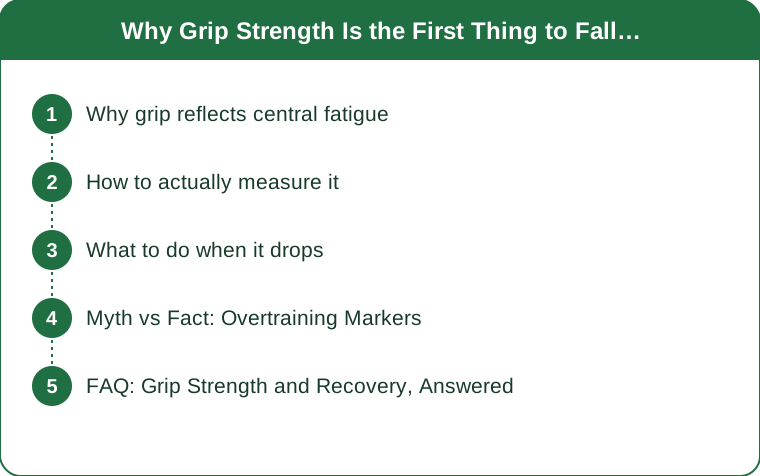
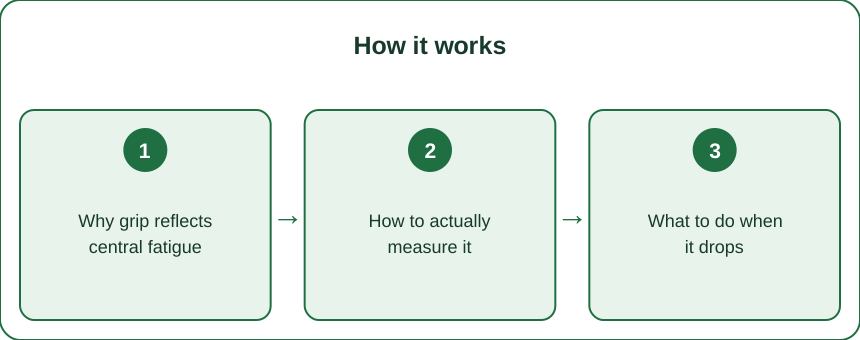
Why grip reflects central fatigue
Maximal grip force depends on how much drive the nervous system sends, not only on forearm muscle size. It is one of the more sensitive available proxies for central readiness.
It is highly repeatable when measured consistently, which matters enormously for a monitoring metric. A measurement with low day-to-day noise can detect a small real change; a noisy one cannot.
It requires no fatigue to obtain. A maximal grip squeeze costs essentially nothing, unlike testing a lift, which both measures and adds to the fatigue you are trying to track.
It responds to sleep loss, illness and psychological stress, which is a feature rather than a confound - those are precisely the inputs that determine whether today’s session should proceed as planned.
And it moves before performance in the main lifts does, because a compound lift can be maintained through technique and motivation for a while after readiness has begun to decline.
How to actually measure it
A hand dynamometer is inexpensive and is the right tool. Anything that gives a number you can compare with yesterday’s number will do; precision against other people’s values does not matter here.
Standardise everything. Same time of day, same arm position, same posture, same hand, before training rather than after. Grip varies meaningfully with all of these, and an unstandardised measurement is noise.
Take three squeezes and record the best. Two is not enough to catch a poor first attempt; more than three starts introducing fatigue.
Build a baseline over two weeks of normal training before interpreting anything. Your own rolling average is the only reference that matters.
Then compare against that rolling baseline, not against your all-time best. Baselines drift with training phase, and a comparison against a peak from March will mislead you all summer.
Around a ten percent sustained drop is the commonly used practical threshold, with a single low day treated as noise and two to three consecutive low days treated as signal.

What to do when it drops
Do not cancel the session; reduce it. Roughly half the planned volume at the same intensity, or the same volume at a clearly lower intensity, is usually enough to allow recovery while maintaining the habit.
Look at sleep first. Sleep debt is the most common cause of a sudden grip drop, and it is also the most fixable one.
Check the obvious non-training inputs. Illness, alcohol, unusual work stress, travel, dehydration and heat all produce genuine drops that are not about your programme at all.
If it stays low for more than a week despite reduced load, take three to five easy days. That is a deload, and taking one early is far cheaper than taking three weeks off later.
Track it alongside one subjective measure - a simple daily readiness rating - because the combination catches more than either alone and takes an extra five seconds.
And be careful attributing a drop to forearm-specific work. Heavy deadlifts, carries or climbing the previous day cause local fatigue that is not central fatigue, which is why the timing of the measurement relative to your training matters.
Myth vs Fact: Overtraining Markers
Myth: resting heart rate is the best early marker. Fact: it is useful but relatively late and quite noisy, moving with heat, alcohol, hydration and sleep timing. Grip typically moves earlier.
Myth: if you can complete the session, you are recovered. Fact: the ability to complete a session persists well past the point where adaptation becomes inefficient. Completion is not readiness.
Myth: true overtraining syndrome is common. Fact: it is rare and takes months to develop. What most people experience is functional overreaching, which resolves in days to a couple of weeks with reduced load - and which is what grip monitoring catches.
Myth: soreness indicates how much recovery you need. Fact: soreness and readiness correlate poorly. Very sore lifters often test fine, and lifters with no soreness at all can show a clear drop.
Myth: monitoring tools have to be expensive. Fact: a basic dynamometer and a notebook outperform most consumer readiness scores, largely because a single well-standardised direct measurement beats an inferred composite.
FAQ: Grip Strength and Recovery, Answered
Which hand should I test?
Your dominant hand, consistently, and only that one. Testing both adds data without adding much information.
Does the time of day matter?
Yes - grip strength varies across the day. Same time, every time, is more important than which time you pick.
Will heavy pulling ruin the measurement the next day?
It can. Local forearm fatigue is real, so note training content alongside the number and interpret the day after heavy carries with that in mind.
How long does it take to recover once it drops?
With reduced load and adequate sleep, typically two to four days. Longer than a week suggests something beyond training load is involved.
Is a persistent drop a reason to see someone?
A drop lasting weeks despite genuine rest, particularly alongside unexplained fatigue, weight change or low mood, is worth a medical conversation. This is general information, not medical advice.
TL;DR:
- Maximal grip depends heavily on central drive, so it falls before main lifts do.
- Measure the same way at the same time daily, best of three squeezes, and build a two-week baseline first.
- A sustained drop of around ten percent over two to three days is a practical signal to reduce load.
- Halve the volume rather than cancelling, and check sleep before you blame the programme.
- Track it with a one-line daily readiness rating; the pair catches more than either alone.
Most people are not overtrained - they are overreached, which resolves in days if you catch it early enough to act on.
Keep Reading
This article is for general informational purposes only and is not medical advice. Always consult a qualified health professional for guidance specific to you.