Why Your Sleep Breaks Before Your Training Does
Quick Answer: Sleep disruption is one of the earliest and most consistent markers of excessive training load, and it typically appears before performance drops. The mechanism is a shift toward sympathetic nervous system dominance — elevated evening cortisol and adrenaline make it harder to fall asleep and easier to wake in the early hours. Because performance is usually maintained for a while by motivation and adrenaline, sleep is the more sensitive early warning, and it is the one people ignore because they blame stress, caffeine or the weather.
You would notice a drop in your numbers. That is what everyone watches.
The problem is that the numbers are the last thing to move, not the first.

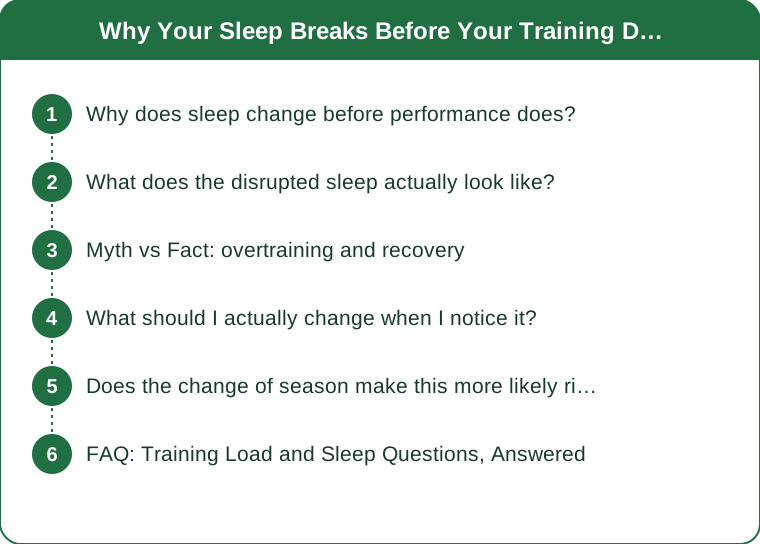
Why does sleep change before performance does?
Because performance has short-term protection and sleep does not.
When training load exceeds recovery, the body increases sympathetic nervous system activity — the fight-or-flight side. In the short term this maintains performance. Adrenaline and elevated arousal let you produce a normal training session on a body that is not recovering properly, which is exactly why the training log looks fine.
But that same elevated arousal is the direct enemy of sleep.
Specifically:
Falling asleep takes longer, because sleep onset requires a drop in arousal and core temperature that an activated nervous system resists.
Early-morning waking, commonly between 2 and 4am. Cortisol naturally begins rising in the second half of the night, and if the baseline is already elevated, it crosses the waking threshold too early.
Sleep feels lighter. Deep slow-wave sleep, which is where most physical recovery happens, is reduced under high sympathetic tone. So the night that is already shorter is also less restorative, which compounds the original problem.
And this is a loop. Poor sleep raises the next day’s stress hormones, which reduces the next night’s sleep quality. That is why the transition from managing to not-managing can happen quite suddenly after weeks of apparently holding steady.
How many nights of disruption is meaningful?
One bad night is life. Three or more disrupted nights in a week, with no obvious external cause, in a period of increasing training load is worth taking seriously.
What does the disrupted sleep actually look like?
There are recognisable patterns, and they differ from ordinary insomnia in useful ways.
The 3am wake with an alert mind. Not anxious, not thinking about anything in particular — just awake, and unusually clear-headed. This is the most reported pattern and it is strongly associated with elevated overnight cortisol.
Falling asleep fine and waking after four hours. Sleep onset is normal because you are physically exhausted; maintenance fails because the underlying arousal is high.
Racing heart on waking. Not a panic attack, but a noticeably fast resting pulse in the early hours.
Vivid, busy dreams and unrefreshing sleep. Sometimes reported alongside reduced deep sleep.
Feeling wired in the evening after an afternoon session. Training too close to bedtime causes this in anyone, but when it starts happening after sessions that never used to cause it, the load is the variable that changed.
What it is not:
- Difficulty falling asleep with a busy, anxious mind is more often ordinary stress than training load.
- Waking to use the bathroom is usually fluid timing.
- Waking at your normal time feeling tired is under-sleeping, not over-training.
The distinguishing feature is the combination: early waking, alertness, elevated resting heart rate, and a rising training load in the preceding two to four weeks.
Myth vs Fact: overtraining and recovery
Myth: Overtraining requires extreme training volumes. Fact: It requires load exceeding recovery, and recovery includes sleep, nutrition, work stress and life stress. A moderate programme during a hard month at work can exceed recovery capacity easily.
Myth: If you can still hit your numbers, you are fine. Fact: Performance is preserved by sympathetic activation well into the problem. It is a lagging indicator, not a reassuring one.
Myth: More sleep will fix it. Fact: It would, if you could get it. The defining problem is that the condition itself is degrading the sleep you need to recover. This is why rest days often do not feel restorative — the load has to come down for the sleep to come back.
Myth: Feeling motivated means you are not overreaching. Fact: Elevated arousal often comes with a period of feeling driven and restless. The loss of motivation arrives later, and by then the problem is well established.
Myth: Soreness is the main indicator of too much. Fact: Soreness tracks novelty and eccentric load more than total stress. Some of the most overloaded athletes are not sore at all.
Myth: A rest week means losing fitness. Fact: Adaptations are realised during recovery, not during training. A well-timed deload usually produces a performance jump, which is exactly why planned deloads exist in serious programmes.

What should I actually change when I notice it?
In order, and the first one is the one people resist.
- Reduce load before you diagnose it. Cut volume by 40 to 50 percent for a week while keeping some intensity. This is a deload, not stopping, and it is far cheaper than the alternative.
- Move hard sessions earlier in the day. High-intensity work within three hours of bed keeps core temperature and arousal elevated at exactly the wrong time.
- Check your resting heart rate on waking, same conditions each morning. A sustained rise of 5 or more beats per minute over your baseline is a well-established load signal, and it pairs with the sleep data.
- Eat enough, particularly carbohydrate. Low energy availability raises cortisol independently, and under-fuelling is one of the most common hidden contributors. Many people who think they have a training problem have an intake problem.
- Protect the sleep window rather than the sleep. You cannot force sleep, but you can guarantee eight hours of opportunity, dark, cool and screen-free at the end.
- Get morning light. It anchors the circadian rhythm and helps re-establish an earlier cortisol peak where it belongs.
- Reassess after seven to ten days. If sleep recovers, the load was the cause and you can rebuild gradually. If it does not, that is worth a conversation with a doctor.
Persistent sleep disruption, a resting heart rate that stays elevated, or fatigue that does not resolve with rest can have medical causes unrelated to training. This is general information, not medical advice — see a doctor if it continues.
Does the change of season make this more likely right now?
It does, and late summer into autumn is a genuinely high-risk window for three separate reasons stacking.
Autumn goal races and events. Training loads peak in August and September for anyone targeting an autumn event. This is the highest-volume block of the year for a lot of people, and it lands right as two other things change.
The light shifts. Daylight is contracting quickly through late August and September, and circadian rhythm is anchored primarily by morning light exposure. Later dawns mean many people lose their morning light signal at exactly the point their training load is highest. Sleep timing drifts, sleep quality falls, and the load-recovery balance tips.
Residual heat stress. Training through the last hot weeks carries a real physiological cost that is easy to under-count. Sessions completed in humidity impose more total strain than the same session in cool air, and if you are calculating load from distance or weight lifted, you are undercounting.
Practical adjustments for the next few weeks:
- Get outside within an hour of waking, even for ten minutes. This is the single highest-value seasonal intervention for sleep, and it becomes more important every week from here.
- Discount your summer sessions upward. Assume a humid session cost more than the numbers say, and plan recovery accordingly.
- Build a deload into early September deliberately, rather than waiting to need one. The transition weeks are where a lot of autumn training blocks quietly break.
- Keep bedtime fixed as the light changes. Drifting later in step with the sunset is the mechanism by which autumn erodes sleep duration.
Should I train less overall in autumn?
Not necessarily less — but recovery needs go up during a seasonal transition, so either load comes down or sleep and nutrition go up. It cannot be neither.
FAQ: Training Load and Sleep Questions, Answered
Can a wearable tell me I am overtraining?
It can flag useful trends — resting heart rate, heart rate variability, sleep duration. It cannot diagnose, and day-to-day readings are noisy. Look at seven-day trends, not single nights.
Is heart rate variability reliable for this?
A sustained downward trend in HRV alongside rising resting heart rate is a reasonable signal. A single low reading means very little.
How long does it take to recover from overreaching?
Short-term functional overreaching typically resolves in days to a couple of weeks with reduced load. Genuine overtraining syndrome can take months, which is the whole argument for catching it early.
Does alcohol make this worse?
Substantially. It suppresses deep sleep and increases early-morning waking, which is the exact pattern already in play.
Should I take a sleep supplement?
Address the load first. A supplement that helps you sleep through an unresolved training overload masks the signal you need.
TL;DR:
- Sleep disruption precedes performance decline, because sympathetic activation props up performance temporarily.
- The signature pattern is early-morning waking with an alert mind, plus an elevated resting heart rate.
- It is a loop — poor sleep worsens the hormonal picture that caused it, so it can tip quickly.
- Fix it by cutting volume 40 to 50 percent for a week, moving hard sessions earlier, and eating enough.
- A sustained 5+ bpm rise in waking heart rate is a well-established corroborating signal.
- Late summer is high-risk: peak training load, contracting morning light and residual heat stress all at once.
- Morning daylight within an hour of waking is the cheapest seasonal fix available.
Your training log is a lagging indicator. Your 3am wake-up is the early one, and it has been trying to tell you for a week.
Keep Reading
This article is for general informational purposes only and is not medical advice. Always consult a qualified health professional for guidance specific to you.