Why Your Resting Heart Rate Jumps a Few Beats After an Especially Hard Training Week
Quick Answer: A resting heart rate elevated by several beats per minute above your normal baseline after a demanding training week reflects your body still working to recover — through elevated cortisol, incomplete glycogen replenishment, and nervous system fatigue — and is one of the most consistent, trackable early signals that more recovery time, not more hard training, is what’s actually needed next.
If your morning resting heart rate keeps reading a few beats higher than usual after pushing hard in training, your body is very directly telling you it’s still catching up.

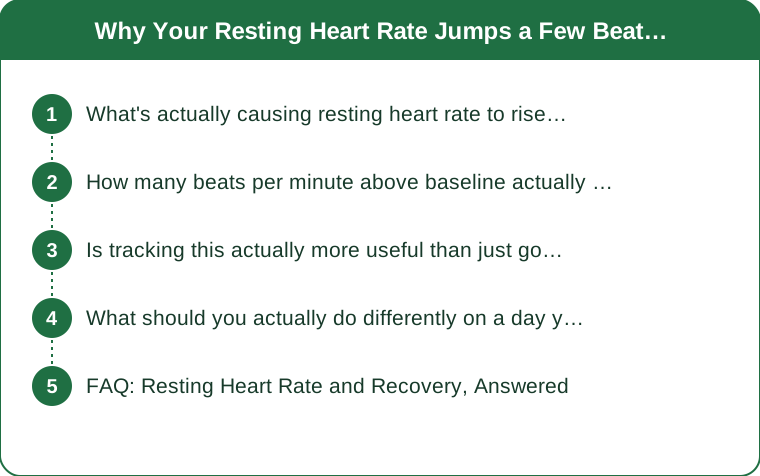
What’s actually causing resting heart rate to rise after hard training?
Elevated stress hormones like cortisol, incomplete glycogen and fluid replenishment, and lingering nervous system activation from intense training all contribute to a temporarily higher resting heart rate as your body works through recovery.
How many beats per minute above baseline actually signals something meaningful?
Generally, an increase of 5-10+ beats per minute above your typical baseline, sustained over multiple mornings rather than just one, is considered a meaningful signal worth adjusting training intensity around.

Is tracking this actually more useful than just going by how tired you feel?
Yes, often — resting heart rate is an objective, trackable metric that can flag incomplete recovery even on days when subjective fatigue feels manageable, catching overreach before it becomes a bigger problem.
What should you actually do differently on a day your resting heart rate is elevated?
Reducing training intensity or volume that day, prioritizing sleep and hydration, and avoiding stacking another hard session on top of incomplete recovery all help resolve the elevation faster than pushing through as normal.
FAQ: Resting Heart Rate and Recovery, Answered
How long does resting heart rate typically take to return to baseline?
Usually 24-72 hours with adequate rest, though it varies based on training intensity and individual recovery capacity.
Do I need a specific device to track this reliably?
A basic fitness watch or even manual morning pulse checks over time can establish a useful personal baseline for comparison.
Is a consistently elevated resting heart rate over weeks a bigger concern than a single day?
Yes — a single elevated morning is normal after hard training, but a sustained multi-week elevation is a stronger signal worth addressing directly, potentially with a coach or physician.
TL;DR:
- Elevated resting heart rate after hard training reflects real ongoing physiological recovery work
- A sustained 5-10+ beat increase above baseline is the meaningful threshold to watch for
- It’s a more objective recovery signal than subjective fatigue alone
- Reducing intensity and prioritizing rest resolves it faster than training through it
Keep Reading
This article is for general informational purposes only and is not medical advice. Always consult a qualified health professional for guidance specific to you.