Why Your Resting Heart Rate Creeps Up Days Before Any Other Overtraining Symptom Shows
Quick Answer: Resting heart rate rises early in overtraining because the autonomic nervous system responds to accumulated training stress before muscular soreness or subjective mood changes become noticeable, making it a faster, more objective early signal than how you feel. A sustained rise of 5-10+ beats above your normal baseline over several consecutive mornings is a widely cited threshold worth acting on.
Of all the overtraining warning signs, resting heart rate tends to show up first — often days before soreness, mood, or performance give any indication something’s off.

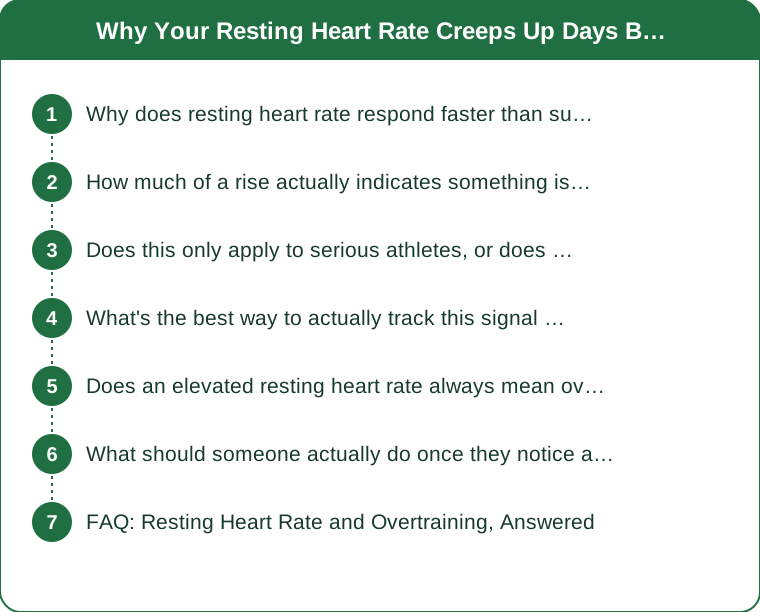
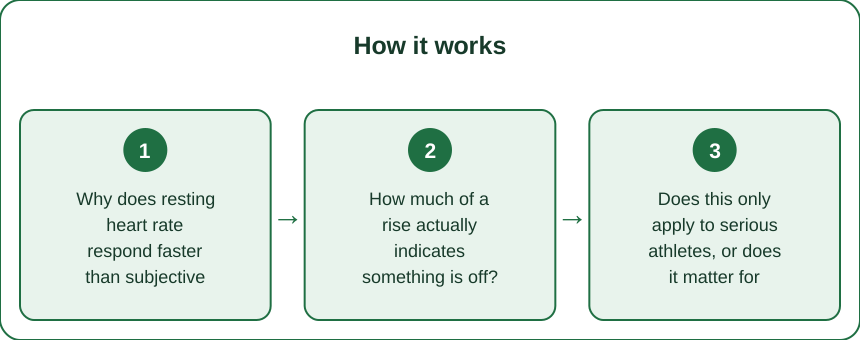
Why does resting heart rate respond faster than subjective feelings of fatigue?
The autonomic nervous system, which regulates resting heart rate, responds to accumulated physiological stress (training load, poor sleep, incomplete recovery) at a physiological level that precedes conscious perception. Subjective fatigue and mood require the brain to register and interpret that stress, which typically lags behind the underlying physiological shift by several days.
How much of a rise actually indicates something is off?
A sustained elevation of roughly 5-10 beats per minute above your typical baseline, held over several consecutive mornings (not a single day’s fluctuation) is a commonly cited threshold in sports science literature for flagging accumulated training stress. A single elevated morning is more likely noise from poor sleep, hydration, or an isolated stressor.
Does this only apply to serious athletes, or does it matter for casual exercisers too?
The mechanism applies to anyone accumulating training stress faster than they’re recovering from it, regardless of competitive level — a casual exerciser ramping up intensity or frequency too fast can show the same early resting heart rate signal as a competitive athlete in a heavy training block.

What’s the best way to actually track this signal accurately?
Measuring first thing upon waking, before getting out of bed or checking a phone, at roughly the same time daily produces the most consistent baseline data — most fitness watches automate this measurement, but manual pulse checks work equally well if done under these same consistent conditions each morning.
Does an elevated resting heart rate always mean overtraining specifically, or could it be something else?
Not always — illness, poor sleep, dehydration, alcohol, and stress can all independently elevate resting heart rate, so an isolated elevated reading shouldn’t be assumed to be overtraining without considering these other common causes first. It’s the pattern (sustained rise tied to a period of heavy training) that points specifically toward overtraining rather than another cause.
What should someone actually do once they notice a sustained rise?
Reducing training intensity or volume for several days to a week, prioritizing sleep, and monitoring whether the resting heart rate returns to baseline is the standard response — if the elevated pattern persists despite reduced training load, that’s a stronger signal worth discussing with a doctor rather than assuming it will self-resolve with rest alone.
FAQ: Resting Heart Rate and Overtraining, Answered
How long does it typically take for resting heart rate to normalize after reducing training load?
Many people see a return toward baseline within a week of meaningfully reduced training, though this varies with how significant the accumulated stress was and how well sleep and nutrition are supporting recovery in the meantime.
Is heart rate variability (HRV) a better signal than resting heart rate?
Both are used and often together — HRV tends to be more sensitive but also more variable day to day, while resting heart rate is simpler to track consistently and still a reliable early signal on its own.
Does age or fitness level change what counts as a meaningful rise?
The percentage or absolute-beat threshold matters more than fitness level for detecting a personal deviation — what matters is the rise relative to your own established baseline, not a universal number.
TL;DR:
- Resting heart rate rises before subjective fatigue because the nervous system reacts faster than perception
- A sustained 5-10+ bpm rise over several mornings is the commonly cited meaningful threshold
- Illness, poor sleep, and dehydration can also elevate it, so consider the pattern, not one reading
- Reducing training load for several days and monitoring for a return to baseline is the standard response
If your morning heart rate is creeping up before you feel anything else off, that’s not a fluke — it’s usually the earliest, most objective overtraining signal available.
Keep Reading
This article is for general informational purposes only and is not medical advice. Always consult a qualified health professional for guidance specific to you.