Why Your Recovery Score Says You Are Fine When You Are Not
Quick Answer: A recovery score measures a narrow slice of your autonomic state overnight. It does not measure accumulated training load, muscle damage, fueling, or motivation - which is where overreaching usually shows up first. In some overreached states, heart rate variability can actually rise rather than fall, so the score reads better while you feel worse. The reliable move is to treat the score as one input of four: the score, your warm-up feel, your morning resting heart rate trend, and whether you want to train at all.
When the score and your body disagree over multiple days, the body has the better record.
Here is why the number can be wrong in the specific direction that gets people hurt.

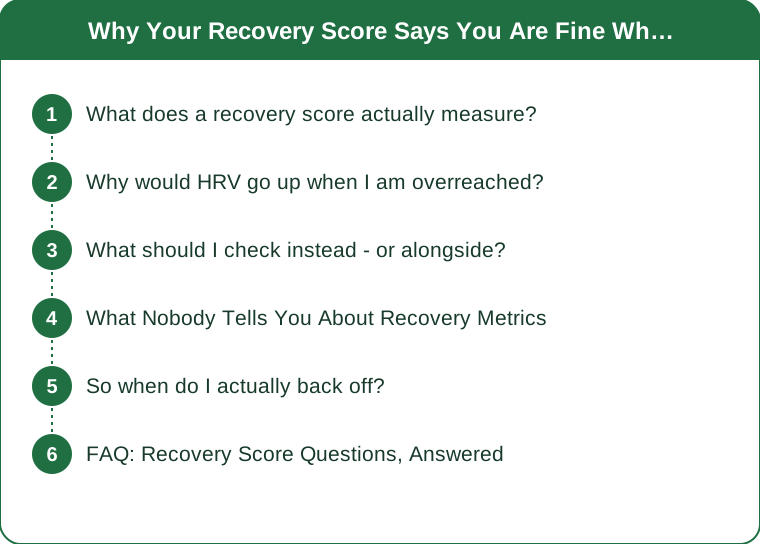
What does a recovery score actually measure?
Less than the name implies.
Nearly all of them are built primarily on overnight heart rate variability plus resting heart rate, sometimes with sleep duration and respiratory rate mixed in. HRV reflects the balance between the sympathetic and parasympathetic branches of your nervous system at the time of measurement.
That is genuinely useful information. It is also information about a single system, measured during a single window, and compressed into one number.
What it does not see:
- Accumulated mechanical load. Muscle and connective tissue damage from a heavy week does not register in autonomic tone.
- Energy availability. Chronic underfueling is one of the most common drivers of the symptoms people call overtraining, and it is invisible here.
- Life stress that has not hit the nervous system yet, or that has and looks identical to training stress.
- Psychological staleness, which is often the earliest reliable signal there is.
And the crucial one: the direction of the HRV change is not always down. Research on functional overreaching has repeatedly found cases where HRV rises or stays flat in athletes who are clearly overreached - a phenomenon often described as parasympathetic saturation. The needle can move the wrong way.
Why would HRV go up when I am overreached?
Because very high parasympathetic dominance and healthy recovery look similar from the outside.
In deep fatigue, the body can shift heavily toward parasympathetic activity as a protective, energy-conserving state. Measured overnight, that shows up as high variability - which the algorithm reads as excellent recovery.
The person in that state does not feel excellent. They feel flat, heavy, and unmotivated, with a warm-up that never quite comes together.
There are other ways the number misleads:
- A rest day inflates it. One easy day produces a good score that reflects yesterday, not the four weeks behind it.
- Alcohol, illness, dehydration, and a late meal all move HRV substantially - sometimes more than training does. A score can be dominated by last night rather than by your training state.
- Baselines drift. Most devices compare you to a rolling personal baseline. If you have been declining slowly for a month, the baseline declines with you and the score keeps saying normal.
That last one is the quiet failure. A slow slide is exactly what the rolling-baseline design is worst at catching.
What should I check instead - or alongside?
Four signals, none of which need a device beyond a clock.
1. The warm-up. This is the best single indicator and it is available every session. In a well-recovered state, the first 10 minutes make you feel better than when you started. In an overreached state, the warm-up feels like the work, and it never resolves. Pay attention to whether you feel better or worse at minute ten.
2. Morning resting heart rate, as a trend. Not one morning - a seven-day average against your usual. A sustained rise of about 5 beats per minute or more is a well-established flag. Measure it the same way every day: same time, before getting up, before caffeine.
3. Motivation. Unglamorous and highly predictive. Loss of desire to train reliably precedes measurable performance decline. If you have talked yourself into the last four sessions, that is data.
4. Performance at a fixed effort. Run your usual easy route at your usual perceived effort and look at the pace, or lift your usual warm-up weight and notice how it moves. A fixed-effort test compares like with like in a way a recovery score cannot.
Rule of thumb: when three of these four disagree with the score, act on the four.

What Nobody Tells You About Recovery Metrics
Five things that change how much weight the number deserves.
The score is calibrated on populations, not on you. Your personal response pattern may differ substantially from the average the algorithm was tuned on. The trend in your own data is far more meaningful than the absolute number.
Checking it before you decide how you feel contaminates the decision. People who read a low score train worse that day even when nothing physiological changed. Decide how you feel first, then look - the order genuinely matters.
Underfueling and overtraining produce nearly identical symptoms and require opposite fixes. Fatigue, poor sleep, low motivation, stalled performance - the overlap is almost total. If you have been in a deficit, add food before you subtract training.
A single bad score means very little. Day-to-day HRV is noisy enough that isolated readings are close to meaningless. Three to seven days of direction is the smallest unit worth acting on.
The device cannot tell you the cause. A low score from a hard workout, a late glass of wine, an argument, and the start of a cold all look the same. You are the only one with the context, which means the interpretation was always your job.
So when do I actually back off?
Use the convergence rule rather than a threshold.
Take a genuine recovery week when three or more of these are true for a week or longer: resting heart rate up about 5 bpm on a seven-day average, motivation clearly down, warm-up feeling worse rather than better, sleep quality dropping, performance flat or declining at a fixed effort, unusual irritability, appetite off.
What a real recovery week looks like: volume cut by roughly half, intensity kept but reduced in quantity, not a total shutdown. Complete rest often feels worse before it feels better because detraining and fatigue clearance overlap - the well-worn cycle where people take three days off, feel terrible, and conclude rest is not working.
Give it 7-10 days before judging. Functional overreaching typically resolves in that window. If several weeks of genuine reduction have not moved anything, that is worth a conversation with a doctor - thyroid issues, iron deficiency, and other conditions imitate this picture closely. This is general information, not medical advice.
And schedule the down week rather than earning it. A planned lighter week every fourth or fifth week prevents most of this. Late summer is the classic pile-up point - a summer of consistent training meets fall race season, and the reduction that should have happened in August gets postponed into an injury in October.
FAQ: Recovery Score Questions, Answered
Should I stop using my wearable?
No - the trend data is genuinely valuable. Change how you use it: look at the seven-day direction rather than today’s number, and check it after you have registered how you feel, not before.
Is a consistently high recovery score always good?
Not necessarily. Very high HRV alongside heavy fatigue and poor performance is a recognized pattern in overreached athletes. Read the score together with performance, never alone.
How long does it take for the numbers to recover after a hard block?
Autonomic markers often normalize in days, while performance and motivation can take one to three weeks. Expect the score to say you are fine before you actually are - which is precisely the failure mode this whole article is about.
TL;DR:
- Recovery scores measure overnight autonomic state, not accumulated load, fueling, or motivation.
- HRV can rise in overreached athletes, so the score sometimes improves as you get worse.
- Rolling baselines drift with a slow decline, hiding exactly the pattern you most want to catch.
- Cross-check with four things: warm-up feel, seven-day resting heart rate, motivation, and fixed-effort performance.
- Back off when three or more signals converge for a week - and plan a lighter week every fourth or fifth week instead of waiting.
Tomorrow morning, write down how you feel before you unlock your phone. A week of that is more useful than a month of scores you read first.
Keep Reading
This article is for general informational purposes only and is not medical advice. Always consult a qualified health professional for guidance specific to you.