Why Overtraining Shows Up in Your Warm-Up Before It Shows Up in Your Workout
Quick Answer: In an accumulated-fatigue state, your warm-up feels wrong before your working sets do — heart rate rises faster than usual for the same easy effort, joints take longer to feel free, and the first few reps feel heavy. That is because warm-up depends on autonomic responsiveness, which degrades earlier than maximal strength does.
Your working sets still look fine on paper. But the last three sessions, the warm-up has felt like a chore, and you have needed twice as long before anything feels normal.
That is not you being unmotivated. The warm-up is the most sensitive part of a session, and it degrades days or weeks before your numbers do.
Here is what to watch, why it happens, and what to do about it.

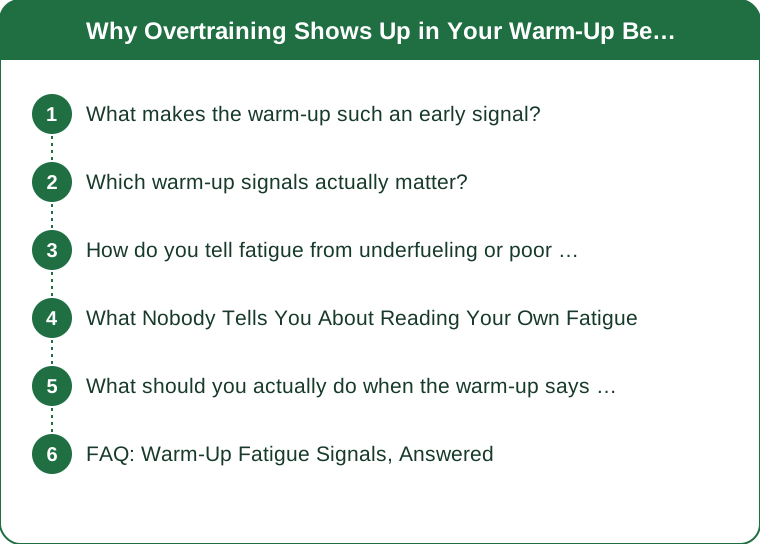
What makes the warm-up such an early signal?
A warm-up is essentially a test of how quickly your body can shift gears.
It requires your autonomic nervous system to pull back parasympathetic tone, raise heart rate smoothly, redistribute blood to working muscle, and raise tissue temperature. All of those are regulatory functions, and regulation degrades before capacity does.
Your one-rep max is a measure of capacity. It is stubbornly resistant to short-term fatigue and can hold up for weeks while everything underneath it deteriorates. That is exactly why it is a terrible early warning.
The warm-up, by contrast, tests responsiveness every single session, at low stakes, before you have committed to anything. It is free data you are already collecting and probably ignoring.
The most useful framing: your working sets tell you what you can still do. Your warm-up tells you what it is costing you.
Which warm-up signals actually matter?
Four, in rough order of reliability.
- Heart rate at a fixed easy effort. If your standard five-minute bike or row warm-up at the same watts now puts you 8-12 beats higher than usual, that is a real signal. Same effort, higher cost.
- Time to feel loose. Most people have a stable number — five minutes, ten minutes. When that number doubles for a week, something is accumulating.
- The first working-weight set feeling heavy. Not the heavy sets. The one you have done a hundred times as a warm-up. When 60% feels like 80%, your nervous system is not recruiting well.
- Breathing pattern in the first five minutes. Feeling like you need to consciously catch your breath during light movement is a strong sign, and it is one people dismiss as being “out of it today.”
One bad day is noise. Three sessions in a row on the same signal is information. Anything you notice for a full week is worth acting on.
How do you tell fatigue from underfueling or poor sleep?
They produce nearly identical warm-up symptoms with opposite fixes, so this matters.
Underfueling typically shows up as a warm-up that feels fine for three minutes and then falls apart, plus lightheadedness on position changes and unusual irritability. The test is straightforward: eat properly for three days, especially carbohydrate around training, and see if it resolves.
Poor sleep shows up as a slow, sluggish warm-up that improves substantially once you are 15 minutes in. Sleep debt hurts the start far more than the middle.
Accumulated training fatigue does not improve as the session goes on. It gets worse. The warm-up feels bad and the third set feels worse than the first.
Illness coming on usually adds an elevated resting heart rate before you even start, plus a warm-up where your heart rate rises fast and does not settle. If that is the pattern, stop — this is the one where training through it costs you the most.
If you cannot distinguish them, the safe move is the same for all four: two easy days. All of them respond to it, and none of them get worse.

What Nobody Tells You About Reading Your Own Fatigue
Motivation drops before performance does. The session you do not want to start is often the first symptom, and it gets misread as a discipline problem. If a normally-enthusiastic person suddenly dreads training for a week, that is data.
Wearables lag your warm-up. Overnight recovery scores are useful, but they are averaging a night that already happened. The warm-up is measuring you right now, on the day, in the state you are actually in.
Feeling good on a deload week is not proof you needed one. Everyone feels good on a deload. The useful question is what the warm-up felt like in the week before it.
Coordination degrades early. Fumbling a barbell setup, misjudging a step, clipping a hurdle — clumsiness in familiar movements shows up before strength loss and almost nobody logs it.
The fittest people fall into this hardest because their capacity holds up so well. They keep hitting their numbers while every regulatory system underneath is fraying, and the crash, when it comes, is bigger.
What should you actually do when the warm-up says stop?
You rarely need to cancel. You need to change the session’s ambition.
The 10-minute rule. Warm up as normal. At ten minutes, decide honestly. If you feel meaningfully better, train as planned. If you feel the same or worse, do a reduced session — same movements, 60% of the volume, nothing near failure.
Cut volume before intensity. For most people, half the sets at the same weight preserves adaptation better than all the sets at a lighter weight, and it costs far less recovery.
Two easy days, not one. One easy day rarely resolves accumulated fatigue and often produces a rebound crash. Two consecutive is the smallest dose that reliably works.
Take a real deload every fourth to sixth week, before you need it. Roughly half your normal volume, intensity maintained. It is much cheaper than the forced two-week break you get from ignoring the signals.
Log the warm-up. One line: heart rate at the same effort, minutes to feel loose, how the first working set felt. Thirty seconds a session, and in a month you will have a personal baseline more useful than any generic metric.
FAQ: Warm-Up Fatigue Signals, Answered
How many bad warm-ups in a row should worry me?
Three consecutive sessions on the same signal, or one full week of any signal, is the threshold to act on. A single bad day is almost always sleep, food, stress, or heat, and training through it is fine.
Should I skip the warm-up if I feel terrible?
No — the opposite. Warming up is the diagnostic. Skipping it removes your best information and takes you into working sets cold, which is when things get hurt. Always warm up; then decide.
Does a longer warm-up fix the problem?
It compensates for it, which is useful on the day and misleading over time. Needing 20 minutes when you used to need eight is itself the signal. Take the longer warm-up if it helps you train safely, and log the fact that you needed it.
TL;DR:
- Your warm-up degrades before your working sets do, because regulation fails earlier than capacity.
- Watch four things: heart rate at fixed easy effort, time to feel loose, how the first working-weight set feels, and early breathing.
- Three bad sessions in a row, or a full bad week, is the threshold to act.
- Fatigue gets worse as the session continues; poor sleep gets better. That distinction tells you which one you have.
- Cut volume before intensity, take two easy days rather than one, and deload before you need it.
The information is already there in the first ten minutes of every session. It costs nothing to write down, and it will catch a problem weeks before your numbers do.
Keep Reading
This article is for general informational purposes only and is not medical advice. Always consult a qualified health professional for guidance specific to you.