Why Motivation Drops Before Performance Does in Early Overtraining
Quick Answer: A drop in motivation to train, even when your actual strength or pace numbers still look fine, is often one of the earliest overtraining signals — it tends to precede measurable performance decline by one to two weeks.
If your workouts still look fine on paper but you’re dreading every session, that gap between numbers and how you feel is worth paying attention to.

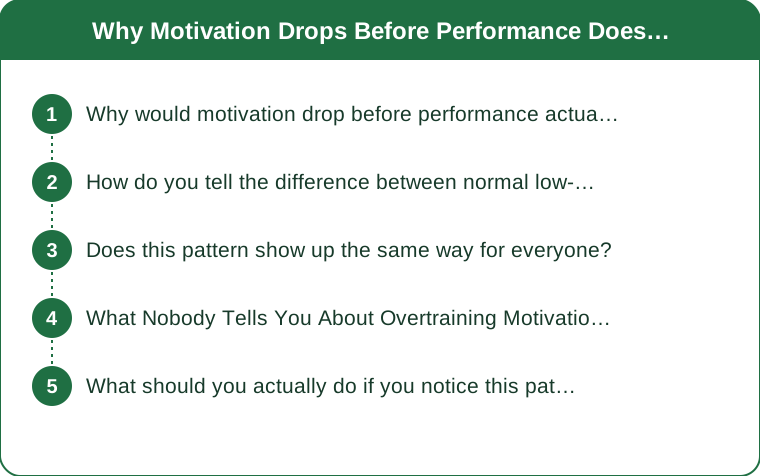
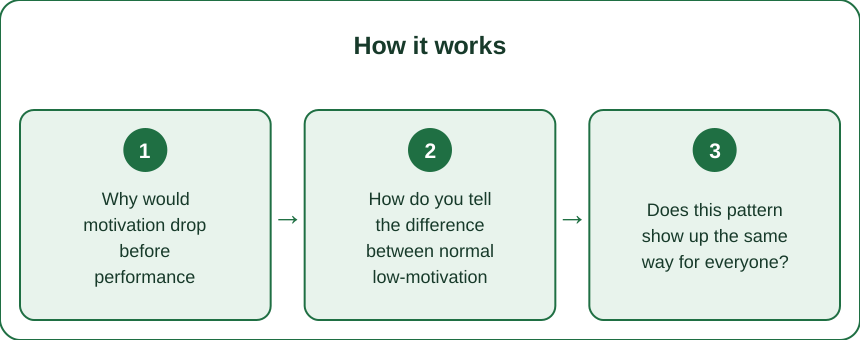
Why would motivation drop before performance actually declines?
Central nervous system fatigue and hormonal shifts associated with accumulating training stress tend to affect subjective drive before they show up as measurable strength or speed loss. This is your body flagging a problem earlier than your workout log will.
How do you tell the difference between normal low-motivation days and an early overtraining signal?
A single off day is normal; a consistent, multi-day drop in the desire to train, especially paired with disrupted sleep or irritability, is the pattern that points toward accumulating fatigue rather than a random bad mood.

Does this pattern show up the same way for everyone?
Not exactly — some people notice appetite changes first, others notice motivation first, and some notice resting heart rate shifts before either. Motivation drop is common, but it’s one signal among several worth tracking together.
What Nobody Tells You About Overtraining Motivation Loss
It’s easy to interpret low motivation as a discipline problem and try to push through it with willpower, but when it’s a physiological early-warning signal, pushing through often accelerates the slide toward more serious overtraining symptoms rather than resolving it.
What should you actually do if you notice this pattern?
A planned lighter week, rather than forcing full intensity, tends to resolve early motivation drops faster than continuing to push. If it persists beyond two weeks despite easing training load, it’s worth discussing with a coach or physician. This is general information, not medical advice.
TL;DR:
- Motivation loss often precedes measurable performance decline by 1-2 weeks
- A multi-day pattern, not a single bad day, is the real signal
- It often shows up alongside sleep or mood changes
- A planned lighter week resolves it faster than pushing through
Treating a sustained motivation drop as data, not a discipline failure, is what catches overtraining before it becomes a forced break.
Keep Reading
This article is for general informational purposes only and is not medical advice. Always consult a qualified health professional for guidance specific to you.