Why Grip Strength Drops Before Your Lifts Do
Quick Answer: Grip strength declines earlier than major lift performance during accumulated fatigue because forearm muscles are small, recover slowly relative to their workload, and are involved in nearly every pulling movement without ever being the focus of programming. A measurable drop in grip often shows up days before squat or bench numbers move, which makes it one of the most practical early warning markers available to a home lifter.
If your big lifts feel normal but your hands keep failing you, that is not a grip weakness problem. It is usually a recovery problem announcing itself in the place it shows up first.

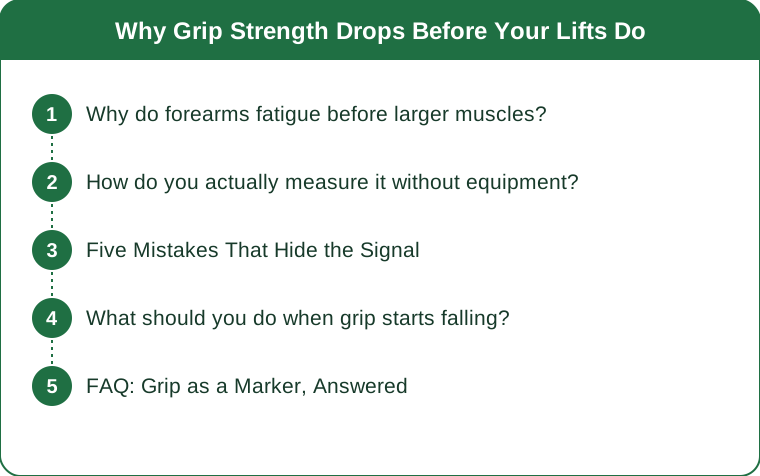
Why do forearms fatigue before larger muscles?
Because of workload distribution, not weakness.
Your forearms are involved in every pull, every carry, every hang, and most machine work. They accumulate volume across your entire program while never appearing in it. A week that includes rows, deadlifts, pull-downs, carries, and dumbbell work might put 40 or more working sets through your grip, compared to perhaps 12 through your quads.
They are also small. Small muscles have less absolute capacity to buffer metabolic stress and a smaller reserve to draw on. The same relative fatigue that a large muscle group absorbs quietly produces a visible performance drop in a forearm.
And grip is a maximal-effort task in a way that most assistance work is not. You either hold the bar or you do not. There is no partial compensation, no other muscle group that quietly takes over, which is exactly what makes it such a clean signal.
Compare that to a squat, where fatigue in one area can be masked by a slight change in bar path, depth, or bracing. The squat number holds because you are compensating. The grip number does not, because you cannot.
How do you actually measure it without equipment?
Three options, in increasing order of usefulness.
Dead hang time. Hang from a bar with a relaxed grip and time it to the point where you must let go. Do this at the same point in your session — ideally before training, on the same day each week. A drop of more than 15 percent from your rolling average is a meaningful signal.
A fixed-load hold. Hold a dumbbell you know well, at a weight you can normally manage for about 45 seconds, and time it. This is more repeatable than a dead hang because bodyweight fluctuation does not affect it.
A dynamometer. If you want a number rather than a proxy, an inexpensive hand dynamometer gives a direct reading in seconds. Take three squeezes per hand and record the best. It is the most sensitive of the three and takes the least time.
Whichever you pick, consistency of conditions matters more than the method. Same time of day, same warm-up state, same hand. A test taken pre-training on Monday and post-training on Thursday tells you nothing.
Build a two-week baseline before you start drawing conclusions. A single low reading is noise; three declining readings in a row is information.

Five Mistakes That Hide the Signal
Using straps for everything. Straps let you keep pulling with a fatigued grip, which is legitimate for training the target muscle — and it also removes your best early warning system. Keep at least one strapless working set per week as a check.
Testing after training. Post-session grip is always low. Testing at inconsistent times produces a graph that reflects your schedule rather than your recovery.
Blaming the equipment. A thicker bar, a new knurling pattern, or humid gym air genuinely changes grip performance. Check whether anything external changed before concluding it is fatigue.
Adding grip training to fix it. If grip is dropping because of accumulated systemic fatigue, more forearm volume makes it worse. Grip training is the answer to a genuine grip weakness, not to a declining trend.
Waiting for the big lifts to confirm it. By the time your squat drops, you are typically one to two weeks into meaningful accumulated fatigue. The whole value of the grip marker is that it fires earlier — acting only after confirmation discards the advantage.
What should you do when grip starts falling?
Treat it as a prompt to look, not as a diagnosis on its own.
First, cross-check against two other markers. Resting heart rate on waking and sleep quality are the two most accessible. If grip is down and resting heart rate is up by 5 or more beats over your baseline, that combination is far more informative than either alone.
If two or three markers agree, the standard response is a deload rather than a stop: keep training frequency, cut volume by roughly 40 to 50 percent, hold intensity near normal, and reassess after five to seven days. Most people recover the grip reading within a week.
If only grip is down and everything else looks fine, look for a local cause instead. Heavy carries, a new pulling exercise, a lot of climbing, or extended manual work outside the gym can drain forearms specifically without any systemic issue at all.
And check the boring inputs. Under-eating and under-sleeping produce this pattern reliably, and both are more common than genuine overtraining. A week of adequate protein and an extra 45 minutes of sleep resolves a surprising share of these cases.
This is general information, not medical advice. Grip weakness accompanied by numbness, tingling, or one-sided loss is a different situation and worth seeing a professional about promptly.
FAQ: Grip as a Marker, Answered
How much daily variation is normal?
Roughly 5 to 10 percent day to day, driven by hydration, time of day, and prior activity. Grip is typically lowest first thing in the morning and peaks in the late afternoon.
Does grip drop before or after motivation does?
Usually around the same time, but grip is measurable and motivation is not. That is the practical argument for tracking it — you get a number instead of a mood.
Should I keep testing during a deload?
Yes, and it is the most useful week to test. Watching the number return is how you confirm the deload was the right call, and how you learn how long your own recovery actually takes.
TL;DR:
- Forearms accumulate volume across your entire program while never being programmed, so they fatigue first.
- Grip cannot be compensated for the way a big lift can, which makes it a clean early signal.
- Test the same way at the same time weekly; a 15 percent drop across three readings is meaningful.
- Cross-check with resting heart rate and sleep before deloading, and check food and sleep first.
Pick one grip test and take it before your next three sessions. Two weeks of data turns a vague sense of being run down into something you can act on.
This is general information, not medical advice.
Keep Reading
This article is for general informational purposes only and is not medical advice. Always consult a qualified health professional for guidance specific to you.