Why Your Grip Goes First When You Are Overtrained
Quick Answer: Grip strength is a well-established marker of whole-body fatigue and central nervous system state, not just forearm condition. It commonly drops 5 to 15 percent during accumulated overreaching, and it does so before squat or run performance visibly declines, because grip is measured in a maximal, brief, highly neural effort with almost no pacing available to mask it. A cheap hand dynamometer or a consistent dead-hang test catches this a week or more before your training log does.
You noticed the jar. You noticed your keys felt heavier. You noticed the bar slipping earlier in your sets.
You did not connect any of it to the training block.
It is one of the earliest honest signals you have.

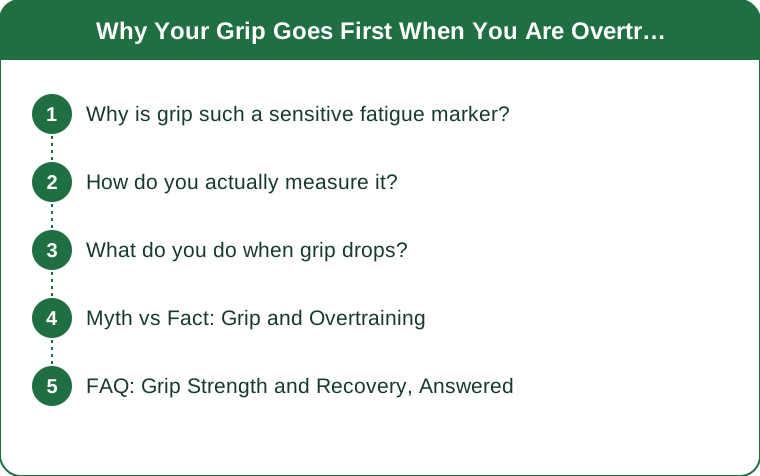
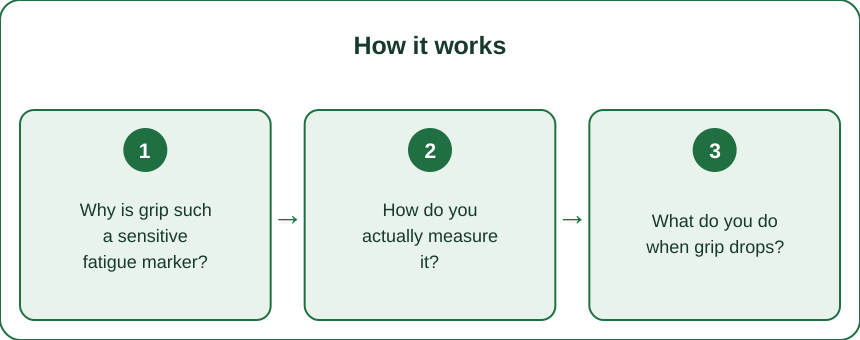
Why is grip such a sensitive fatigue marker?
Because it is a nearly pure measure of neural drive with very little room to compensate.
Grip is a maximal, brief effort. There is no pacing, no technique adjustment and no cardiovascular buffer. Whatever your nervous system can produce right now is what you get.
It reflects central state, not local condition. Research on fatigue consistently finds grip declines with sleep loss, illness, caloric deficit and psychological stress, none of which are forearm-specific.
Your forearms are rarely the trained bottleneck. Because you are not usually training grip to failure, a drop in grip is not explained by local soreness the way a slow squat might be.
Compensation is impossible. In a squat you can shift load, change tempo or use better bracing to hold a number while fatigued. There is no equivalent trick for squeezing.
It is measurable daily without fatigue cost. A three-second maximal squeeze does not interfere with training, which is why grip is used as a monitoring tool in athletic settings.
And it correlates with the stuff you care about. Reduced grip during heavy blocks tends to precede reduced power output and reduced training quality by roughly 5 to 10 days in practice.
How do you actually measure it?
Two options, one costs about the price of a supplement tub and one is free.
Hand dynamometer. Around 20 to 40 dollars. Test at the same time of day, same posture, three attempts per hand, record the best. Establish a baseline over 5 to 7 days when you are fresh.
Dead hang for time. Free, and nearly as informative. Same bar, same grip width, same time of day, hang to a hard stop rather than absolute failure. Record seconds.
Test before training, never after. Post-session numbers reflect that session, not your accumulated state.
Same time of day, always. Grip varies through the day by a meaningful margin, usually peaking in the afternoon.
Watch the trend, not the day. A single low reading is noise. Three consecutive days more than 10 percent below baseline is a signal worth acting on.
Note the context. Poor sleep, illness, a heavy meal, cold hands and caffeine all move the number. Cold hands in particular can cost several percent, which matters as autumn arrives and gyms get colder.

What do you do when grip drops?
Reduce load before you reduce enjoyment. The earlier you catch it, the smaller the intervention.
Drop volume first, not intensity. Cutting sets by 30 to 40 percent for a week while keeping some heavy work preserves adaptation better than going easy on everything.
Check the obvious inputs before restructuring training. Sleep duration, total food intake and life stress explain a large share of grip declines. Underfueling and overtraining produce near-identical symptoms and require opposite fixes.
Look at your last three weeks, not your last three days. Accumulated load is the driver. A single hard session does not do this.
Keep the movement, cut the strain. Continue training patterns at reduced load rather than stopping entirely. Complete rest tends to feel worse before it feels better.
Retest after 5 to 7 days. If grip has recovered to within 5 percent of baseline, resume progression. If not, the problem is likely nutritional or sleep-related rather than training volume.
Seasonal note: late summer into autumn is a classic accumulation point. Summer training often ran on long evenings and good sleep, and the transition to darker mornings, colder gyms and a return to a busier schedule compresses recovery quietly. If your grip is drifting down in September and your training has not changed, look at the rest of your life first.
Myth vs Fact: Grip and Overtraining
Myth: Weak grip just means you need more forearm work
Fact: A sudden decline from your own baseline is a fatigue signal. Adding grip training on top of it makes it worse.
Myth: If your main lifts are still fine, you are fine
Fact: Main lifts have technique and pacing buffers that hide fatigue for a week or more. Grip does not.
Myth: Grip only matters for lifters
Fact: Runners, cyclists and general trainees show the same pattern. It is a systemic marker, not a sport-specific one.
Myth: You need lab equipment
Fact: A timed dead hang tracks the same trend for free, provided you keep conditions consistent.
Myth: A single bad reading means take a week off
Fact: One reading is noise. Three consecutive days below baseline is a signal.
Myth: Grip recovers last
Fact: It tends to recover relatively quickly once load drops, which is exactly what makes it useful as a monitoring tool rather than a lagging indicator.
FAQ: Grip Strength and Recovery, Answered
How much of a drop actually matters?
More than 10 percent below your personal baseline for three consecutive days is the practical threshold most monitoring approaches use.
Does cold weather affect the reading?
Yes, noticeably. Warm your hands for a minute before testing, and be consistent about it year-round.
Can underfueling cause this without overtraining?
Absolutely, and it is the most commonly missed cause. The symptoms overlap almost completely, so check intake before cutting training.
Should I test on rest days too?
Yes. Rest-day readings are the cleanest, because no session is contaminating them.
Is dead hang time as good as a dynamometer?
For trend tracking, close enough. For absolute comparison across people, no.
When should I see a professional?
If grip loss is one-sided, accompanied by numbness or tingling, or does not recover with reduced load, that is a different problem. This is general information, not medical advice.
TL;DR:
- Grip is a maximal neural effort with no pacing buffer, so it reports systemic fatigue early.
- Expect a 5 to 15 percent drop during accumulated overreaching, often 5 to 10 days before performance falls.
- Measure with a dynamometer or timed dead hang, before training, same time of day.
- Act on three consecutive days more than 10 percent below baseline, not on one bad reading.
- Check sleep and food intake first; underfueling mimics overtraining exactly.
Test it tomorrow morning, and again in a week. It is the cheapest early-warning system in training.
Keep Reading
This article is for general informational purposes only and is not medical advice. Always consult a qualified health professional for guidance specific to you.