Training Stress Plus Life Stress: The One Budget Your Body Draws From
The body doesn’t keep separate accounts — the deadline week, the sick kid and the interval session all draw from one stress budget — and the athlete who trains hard through life chaos isn’t tough, she’s overdrawn. The unified-ledger guide: the physiology, the dashboard and the flexible program.


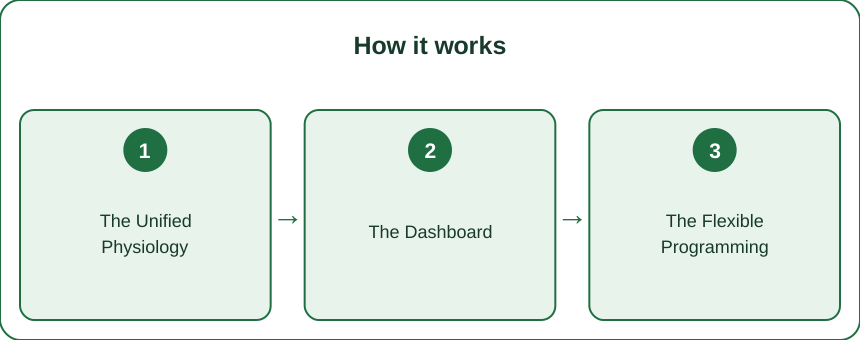
The Unified Physiology
One system, all stressors: the shared-pathway truth (the training stress and psychological stress running through the same hormonal machinery — the cortisol-and-nervous-system commons from the cortisol doctrine; the body responding to the total, not the source), the recovery-competition principle (the adaptation requiring recovery resources — the life stress consuming exactly those resources; the same workout costing double in a brutal week), the research receipts (the studies linking life stress to slower strength gains, worse muscle recovery and higher injury rates — the stressed-semester athletes healing slower in the classic data), the sleep intersection (the stress that fragments sleep gutting the recovery hormone environment — the sleep doctrine as the ledger’s clearing house), and the reframe (the question shifting from ‘did I train too much’ to ‘did I stress too much total’ — the overtraining that’s often under-recovering from life).
The Dashboard
Reading the whole ledger: the morning signals (the resting heart rate drift, the sleep quality, the mood-and-motivation check — the readiness dashboard from the tracking doctrine; the two-minute morning audit), the performance canaries (the warm-up weights that feel heavy, the paces that cost more — the session RPE trending up at constant loads being the classic overdraft alarm), the life-load inventory (the week’s non-training stressors named honestly — the work crunch, the relationship strain, the caregiving from the caregiver doctrine; the invisible load made visible), the subjective-scoring habit (the simple 1-10 daily stress-and-energy log — the trend that predicts better than any gadget per the journal doctrine), and the honesty culture (the ‘how am I actually’ answered without athlete bravado — the toughness that ignores the ledger being the injury pipeline per the masters doctrine).

The Flexible Programming
Training by the ledger: the traffic-light system (the green-day full program, the yellow-day volume-halved, the red-day walk-and-mobility — the pre-decided tiers from the condition doctrine removing the daily negotiation), the hard-day placement (the intense sessions scheduled AWAY from the week’s stress peaks — the interval day moved off the presentation day; the calendar-aware programming), the maintenance-mode seasons (the brutal life chapters trained at the minimum effective dose from the minimal doctrine — the two-session floor that holds fitness while life spends the budget; the maintenance-is-victory doctrine), the compensatory-recovery moves (the high-stress weeks adding recovery inputs — the extra sleep, the walks, the breathwork from the calm doctrine; the ledger balanced from both sides), the deload synchronization (the deload week aligned with the life crunch per the deload doctrine — the schedule’s chaos converted to the program’s rhythm), and the return-to-full protocol (the green weeks re-entered gradually after red seasons — the comeback doctrine applied to stress recovery).
The Bigger Frame
The ledger as wisdom: the training-as-stressor-and-medicine paradox (the exercise both drawing from and expanding the budget — the moderate movement that relieves stress versus the intense session that adds it; the dose making the poison per the exercise-immunity doctrine), the guilt retirement (the downgraded session during chaos being CORRECT programming, not weakness — the athlete managing the whole ledger outperforming the one managing only the training column), the periodization-of-life concept (the year’s known stress seasons planned around — the tax-season accountant and the harvest-season teacher programming their training years honestly), the relationship dividend (the ledger-aware athlete being livable — the training that flexes for the family per the household doctrine), and the closing principle (the body as one account, spent wisely — the fitness built sustainably on whatever budget life leaves; the strongest athletes being the best accountants; the ledger, finally read whole). One budget, traffic-light days, hard sessions away from life peaks: the whole ledger, managed.
Training and life stress draw from one budget — the deadline week makes the same workout cost double. Run traffic-light days off a two-minute morning check, place hard sessions away from stress peaks, and treat maintenance mode as correct programming.
Keep Reading
This article is for general informational purposes only and is not medical advice. Always consult a qualified health professional for guidance specific to you.