Why Your Sleep Gets Worse Right Before Overtraining Symptoms Show Up
Quick Answer: Elevated cortisol and sympathetic nervous system activity from accumulated training stress disrupt sleep architecture before more visible overtraining symptoms like performance drops or persistent soreness appear, making poor sleep quality one of the earliest reliable warning signs to track.
By the time performance clearly drops, overtraining has usually been building for a while — sleep often signals it days earlier.

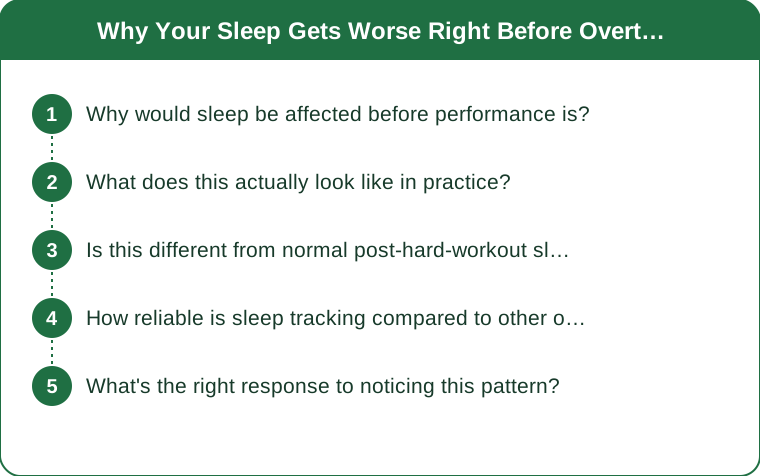
Why would sleep be affected before performance is?
Training stress raises cortisol and keeps the sympathetic nervous system more active than usual, and that hormonal and nervous system state directly interferes with the transition into deep sleep stages before it measurably affects daytime output. The disruption starts internally before it shows up externally.
What does this actually look like in practice?
Commonly reported patterns include falling asleep fine but waking multiple times, or waking earlier than usual despite feeling tired — both signs of lighter, more fragmented sleep architecture rather than classic insomnia.

Is this different from normal post-hard-workout sleep disruption?
Yes — a single hard session might disrupt one night’s sleep, but overtraining-related disruption tends to persist across multiple consecutive nights and doesn’t resolve with a single rest day, which is the distinguishing pattern to watch for.
How reliable is sleep tracking compared to other overtraining signals?
Sleep quality tends to shift earlier than resting heart rate or HRV changes for many people, making it a useful complementary signal rather than a replacement — tracking both together gives a more complete picture than either alone.
What’s the right response to noticing this pattern?
Treating several consecutive nights of disrupted sleep as an early flag, rather than waiting for a clear performance drop to confirm it, allows for a lighter training adjustment before the more disruptive full overtraining symptoms set in.
TL;DR:
- Elevated training-related cortisol disrupts sleep before performance visibly drops
- Multi-night fragmented sleep, not one bad night, is the pattern to watch
- Sleep often shifts earlier than resting heart rate or HRV changes
- Acting on early sleep disruption can prevent a fuller overtraining episode
This is general information, not medical advice — persistent sleep disruption alongside other symptoms is worth discussing with a professional.
Keep Reading
This article is for general informational purposes only and is not medical advice. Always consult a qualified health professional for guidance specific to you.