Why Your Resting Heart Rate Spikes After a Hard Training Week
Quick Answer: A resting heart rate that’s 5-10 beats above your normal baseline for 2+ mornings in a row usually means your nervous system hasn’t recovered from recent training load. Treat it as a signal to cut intensity for a few days, not push through.
You wake up, check your watch out of habit, and the number looks wrong. Not dramatically wrong — just 6 beats higher than the 58 you’re used to seeing. You feel fine, so you shrug it off. That’s exactly the moment worth pausing on.

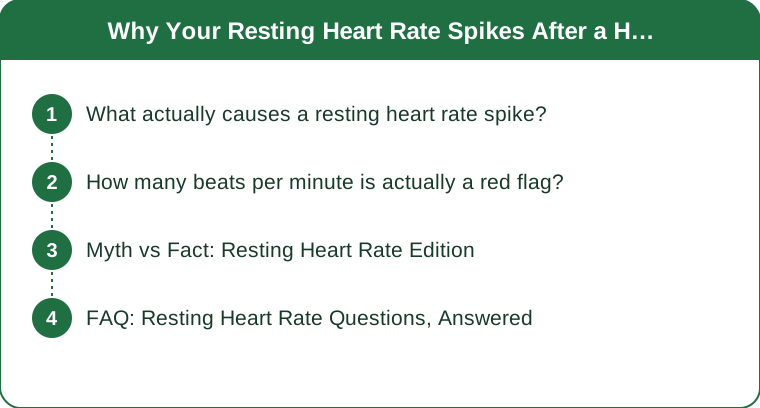
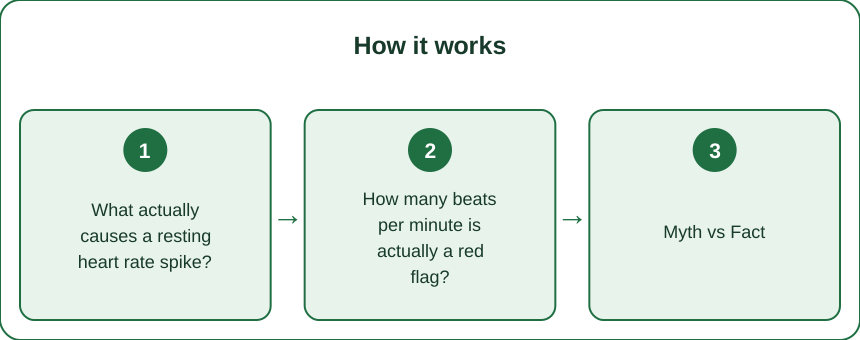
What actually causes a resting heart rate spike?
Your resting heart rate (RHR) reflects how hard your autonomic nervous system is working just to keep you upright and functioning. After a demanding training block, your body is still processing cortisol, inflammation, and incomplete muscle repair — all of which nudge RHR upward even while you’re lying still.
A single elevated morning (say, after poor sleep or a late dinner) means little. Two or more mornings in a row, 5+ beats above your rolling 7-day average, is the pattern that matters.
How many beats per minute is actually a red flag?
Sports science generally treats a sustained rise of 5-10 bpm above baseline as a meaningful signal, not noise. Under 3 bpm is normal day-to-day variation from sleep, hydration, or stress.
The fix isn’t complicated: drop intensity (not necessarily volume) for 2-3 days — swap intervals for zone 2 cardio or a full rest day — and recheck each morning. Most people see RHR normalize within 3-4 days if they actually back off.

Myth vs Fact: Resting Heart Rate Edition
Myth: A higher RHR always means you’re getting sick. Fact: Illness is one cause, but training load, poor sleep, alcohol, heat, and travel all move the number. Context matters more than the number alone.
Myth: Fitness trackers are too inaccurate to trust for this. Fact: Wrist-based trackers are noisy for single readings but reliably show trend direction across a week — which is exactly what you need here.
Myth: You should just push through and let your body adapt. Fact: Training through a sustained RHR spike is how a normal recovery week turns into 3 weeks of flat, tired workouts.
FAQ: Resting Heart Rate Questions, Answered
What’s a normal resting heart rate for an active woman?
Most fall between 50-70 bpm, with well-trained endurance athletes sometimes lower. Your own baseline matters more than any general chart — track your rolling average for 2 weeks to know it.
Does one bad night of sleep count as a spike?
Usually not on its own — a single night can bump RHR 2-4 bpm. Look for the pattern holding across 2+ consecutive mornings before changing your training.
Should I take a full rest day or just go lighter?
Going lighter (zone 2, mobility, a walk) usually works as well as full rest and keeps the habit going. Reserve full rest for when RHR is still elevated after 3 easy days.
TL;DR:
- A 5-10 bpm rise above your baseline for 2+ mornings is a real recovery signal, not noise
- Trend over days matters more than any single morning’s number
- Drop intensity, not necessarily volume, for 2-3 days and recheck
- Persistent elevation past a week deserves a closer look — sleep, illness, or true overtraining
Check the trend, not the number. Your watch is more useful as a pattern-spotter than a daily verdict.
Keep Reading
This article is for general informational purposes only and is not medical advice. Always consult a qualified health professional for guidance specific to you.