Overtraining and Underfueling Look Identical, and the Fixes Are Opposite
Quick Answer: Overtraining and low energy availability produce nearly the same symptom list: fatigue, poor sleep, elevated resting heart rate, mood dip, stalled performance. The distinguishing test is what happens after a genuine deload. Overtraining improves within one to two weeks of reduced volume. Underfueling does not improve on rest alone, and can worsen, because reducing training reduces appetite while the energy deficit stays.
You took the recovery week. You slept more. You did everything the article said, and you feel the same or slightly worse. That outcome is information, and it is pointing at food, not volume.

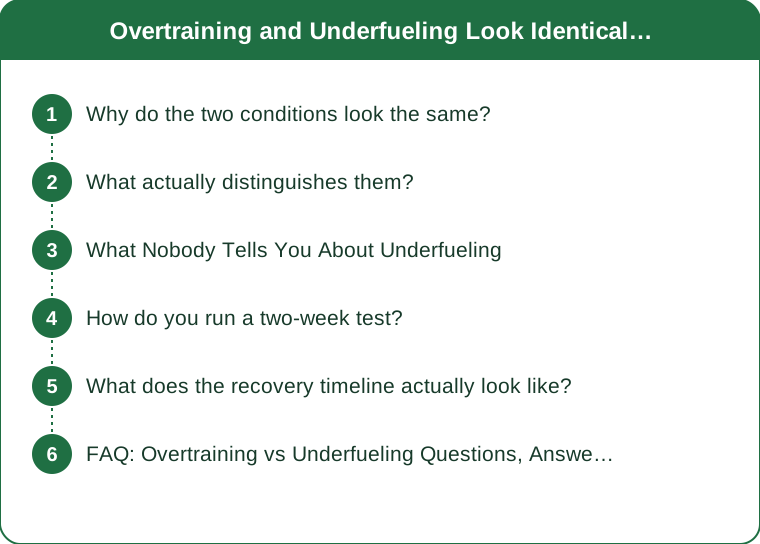
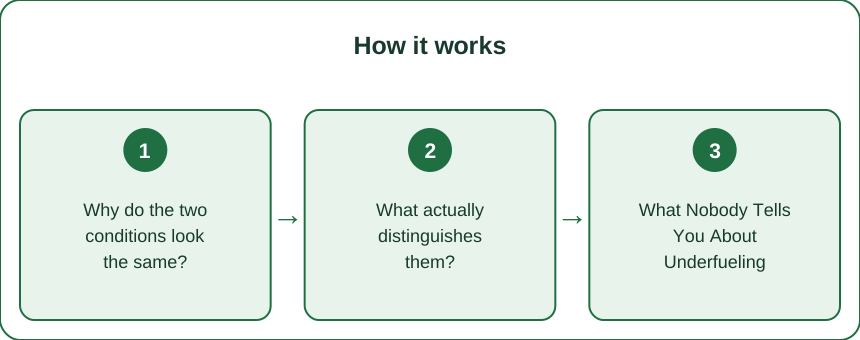
Why do the two conditions look the same?
Because your body has one general alarm and several possible causes for it.
Both overtraining and low energy availability push the same downstream levers: sympathetic nervous system upregulation, blunted recovery hormone response, disrupted sleep architecture, and reduced work capacity. The body does not have separate symptom sets for “too much stress” and “not enough fuel.” It has one.
Low energy availability, the condition underlying what sports medicine now calls RED-S, is defined by energy intake minus exercise energy expenditure falling below what the body needs for basic function. Notably it does not require a large training load. A moderate training week with insufficient intake produces it just as reliably as a huge week with adequate intake.
Which means the classic assumption, that these symptoms mean you trained too much, is a coin flip.
What actually distinguishes them?
Four practical markers separate the two more reliably than symptoms do.
Response to a deload. The clearest one. A true overtraining state improves noticeably within seven to fourteen days of cutting volume by half while keeping intensity touches. Underfueling does not, because the deficit persists and appetite often drops further when training drops.
Appetite direction. Overreaching typically increases hunger. Chronic underfueling frequently suppresses it, which is one of the crueler features of the condition, since the symptom actively prevents the fix.
Cold hands and feet, and feeling cold generally. This leans strongly toward energy availability. The body downregulates thermogenesis when fuel is short. Overtraining does not usually make you cold.
Menstrual changes. In people who menstruate, a cycle that gets longer, lighter, or disappears is one of the most specific signals of low energy availability there is, and it warrants a clinician’s input rather than a training tweak.
What Nobody Tells You About Underfueling
It rarely feels like restriction. Most people in a chronic deficit are eating what feels like a normal amount. The deficit comes from expenditure rising while intake stays flat, not from deliberate cutting. Adding four training hours a week without adding food is enough.
Weight can be completely stable. Metabolic adaptation is real and can hold weight steady while function quietly degrades. Using the scale as your check will tell you everything is fine while your resting heart rate climbs.
Carbohydrate timing matters more than total protein here. The protein message is so loud that people in a deficit often have adequate protein and badly inadequate carbohydrate. Central fatigue and poor training tolerance track carbohydrate availability closely.
The stubborn one: rest days are when the deficit gets worse. People eat less on rest days because they trained less, but recovery is when the repair bill actually comes due. Eating slightly more on rest days than on easy training days feels wrong and is usually correct.
And the piece that catches experienced athletes: the symptoms are worst at the point where you are handling the training well. Adaptation to the load can mask the fuel problem for months, and it surfaces suddenly.

How do you run a two-week test?
Do not change both variables at once. That is how people spend a season guessing.
Week 1: fuel test. Keep training exactly as it is. Add roughly 400-500 kcal per day, weighted toward carbohydrate, and put most of it around training. Track morning resting heart rate, sleep quality on a simple 1-5 scale, and how the first ten minutes of each session feels.
If things improve in week one while training was unchanged, the problem was fuel. That is a clean answer.
Week 2: volume test, only if week 1 changed nothing. Cut volume by half. Keep two short intensity touches so you do not detrain. Hold the increased intake.
If things improve now, volume was a contributor. If neither week moves the needle, stop self-diagnosing and get bloodwork. Iron deficiency, thyroid dysfunction, and sleep apnea all sit inside this same symptom cluster and none of them respond to training changes.
This is general information, not medical advice. Absent periods, resting heart rate elevated more than 10 bpm for over two weeks, or symptoms with unexplained weight change should be evaluated by a clinician.
What does the recovery timeline actually look like?
Faster than people fear for fuel, slower than people hope for genuine overtraining.
Correcting a mild energy deficit produces noticeable changes in energy and sleep within three to seven days. Resting heart rate typically follows within two weeks. Performance lags a bit behind subjective feel, which frustrates people who expect the numbers to move first.
True overtraining syndrome, as opposed to the much more common functional overreaching, can take weeks to months. Functional overreaching, the normal state after a hard block, resolves in one to two weeks of reduced load and is a sign the block worked.
The practical implication is that the fuel test is worth running first every single time, because it is faster, cheaper, and carries no detraining cost. Cutting volume when the problem was food costs you fitness and does not fix anything.
FAQ: Overtraining vs Underfueling Questions, Answered
Can I have both at once?
Yes, and it is common. A big training block plus unchanged intake produces both simultaneously. Correct fuel first, because adding food while maintaining training is the lower-risk intervention and often resolves enough of the picture to see clearly.
Is a rising resting heart rate always bad?
No. Single-day spikes track sleep, alcohol, heat, and illness far more than training. A trend of five or more days climbing above your normal range is the meaningful signal, not any one morning.
How much is 400-500 kcal in practical food?
A bowl of oats with banana and peanut butter, or a bagel with cream cheese plus a glass of juice. It is a small addition, which is exactly why the deficit builds without anyone noticing it.
TL;DR:
- Both conditions produce the same fatigue, sleep, heart rate, and mood symptoms
- Deload response is the cleanest test: overtraining improves in 1-2 weeks, underfueling does not
- Feeling cold, dropping appetite, and cycle changes point strongly toward fuel
- Run the fuel test first, since it costs no fitness and answers faster
If a proper recovery week left you feeling the same, stop taking recovery weeks and start eating breakfast. And if two weeks of both changes nothing, get bloodwork rather than another training theory.
Keep Reading
This article is for general informational purposes only and is not medical advice. Always consult a qualified health professional for guidance specific to you.